Bright Data is one of the largest proxy and web data providers: a strong choice for businesses that need a huge residential network, strict compliance and ready-made scraping APIs, but an expensive one for individuals and small projects. Residential traffic lists at $8/GB pay-as-you-go, and since October 2026 residential and mobile access requires a KYC-verified business account. In this 2026 review we cover the features, current pricing and best uses of Bright Data proxies, and compare it with cheaper options.
Key Takeaways
- Bright Data offers residential, datacenter, mobile, and ISP proxies, plus scraping APIs, cloud browsers and datasets.
- Its residential network has 400M+ monthly IPs across 195+ countries, with country, city, ZIP and ASN targeting.
- Residential traffic lists at $8/GB pay-as-you-go; monthly plans and promotions lower the per-GB price.
- Residential and mobile proxies now require a KYC-verified business account, under a policy effective 19 October 2026.
- Bright Data states GDPR and CCPA compliance and holds ISO/IEC 27001, 27017 and 27018 and SOC 2 Type II certifications.
Overview of Bright Data Proxy Services
Bright Data (formerly Luminati Networks) provides proxy and data collection infrastructure for web scraping and data gathering. Its proxy services include:
- Residential proxies
- Datacenter proxies
- Mobile proxies
- ISP proxies
Each network is tailored to different data collection needs, and the open-source Bright Data Proxy Manager helps route traffic between them. Large companies use these services for market research, price monitoring, ad verification and training-data collection.
Beyond raw proxies, Bright Data sells managed products that handle blocking for you — the Web Unlocker API, SERP API, Browser API and pre-built Scraper APIs — so teams can choose between running their own scrapers and buying finished data.
Next, we’ll explore the types of proxies Bright Data offers and their key features.
Types of Proxies Offered by Bright Data
Bright Data offers four main types of proxies:
- Residential proxies
- Datacenter proxies
- Mobile proxies
- ISP proxies
Each proxy type serves a different purpose.
Residential proxies are the core of Bright Data’s offering, with 400M+ monthly IPs from real users who have opted in to the network. They are the best fit for protected sites, geo-restricted content and market research. Datacenter proxies — over 1.6 million IPs in 98+ countries, according to Bright Data’s documentation — are the fastest and most cost-effective option for sites without sophisticated blocking, and are commonly used for competitor tracking and ad verification.
Mobile proxies route traffic through real 3G/4G/5G connections, with Bright Data advertising 7M+ mobile IPs, which makes them useful for mobile-specific data and testing. ISP proxies are static IPs leased from internet service providers — 1.3M+ of them — that websites classify like residential IPs while they run on fast server infrastructure.
Key Features of Bright Data’s Proxy Network
Bright Data’s network handles IP selection and rotation automatically and keeps sessions sticky when you need the same IP for a sequence of requests, which helps avoid IP bans during web scraping. Coverage is global, so you can collect localized content such as regional prices and language versions.
For browser-based scraping, the Browser API (formerly Scraping Browser) runs your Puppeteer, Playwright or Selenium scripts on Bright Data’s cloud browsers with unblocking built in. Teams that prefer not to write code can use Scraper Studio or pre-built Scraper APIs, and a dashboard lets you track usage per zone.
Residential Proxies from Bright Data
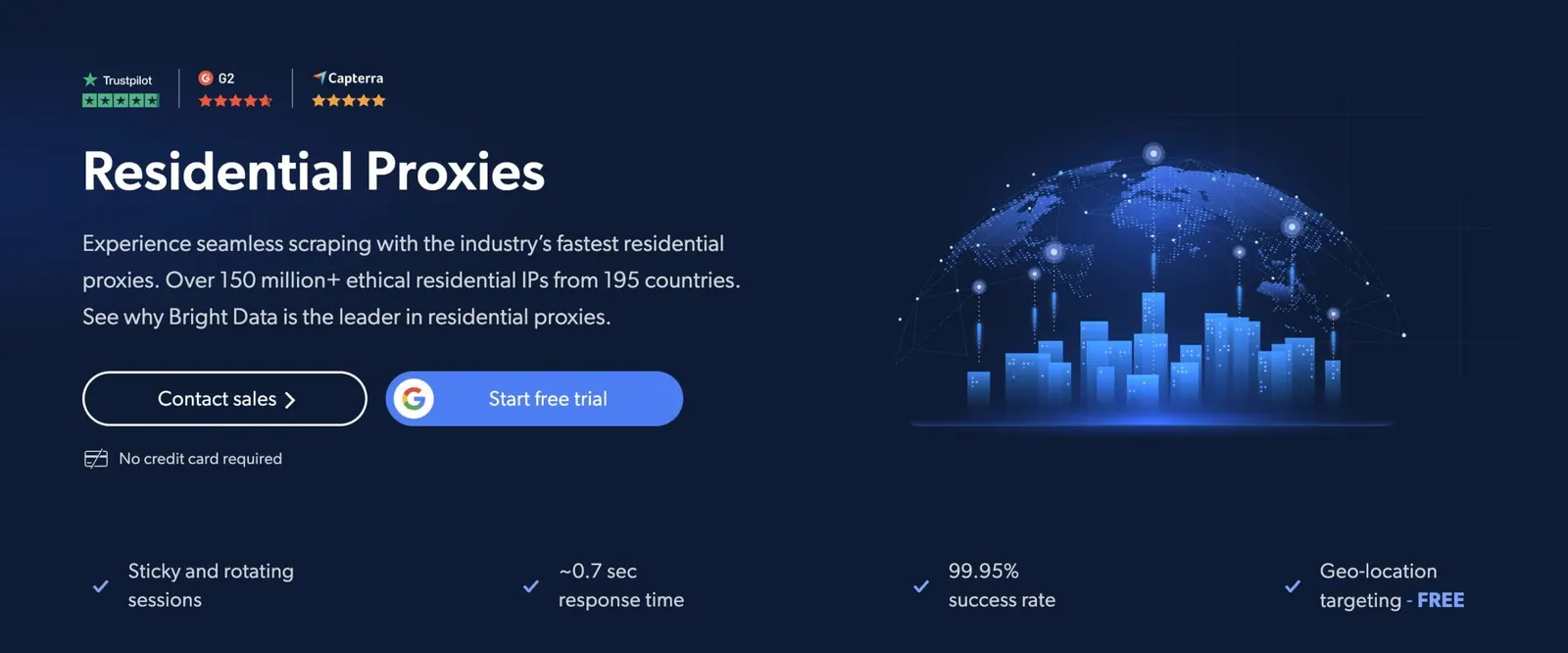
Bright Data’s residential proxy pool consists of 400M+ monthly IP addresses in 195+ countries, making it one of the largest in the market. These proxies let you access geo-restricted content by connecting through IPs located in the countries you target.
Geo-targeting goes down to country, city, ZIP code and ASN level, which makes the residential network suitable for tasks such as checking localized search results, managing regional social media profiles and gathering e-commerce data.
Since 19 October 2026, residential access requires a KYC-verified business account. Bright Data has retired “immediate access” residential and mobile proxies and points customers without KYC to ISP proxies or the Web Unlocker API.
Benefits of Using Residential Proxies
Residential proxies use legitimate IP addresses from real devices, which makes it much harder for websites to tell automated requests from ordinary visitors. Bright Data says participants opt in to the network and are compensated for it.
The large pool also lowers the chance of hitting an address that a target site has already blocked, and the network can keep a sticky session on one IP when a task needs a persistent connection.
How Residential Proxies Work
When you send a request through the residential network, Bright Data routes it through a residential device in your chosen location. Only the proxy’s IP is visible to the destination server, so your real IP stays hidden and the request looks like it comes from a local user.
Response times vary more than with datacenter proxies, because each request depends on the connectivity of the real device behind the IP.
Datacenter Proxies Explained

Bright Data’s datacenter proxies are designed for high-speed data extraction. With a shorter route and simpler architecture, they are the fastest and most economical proxy type the company sells, which makes them ideal for large projects on sites that do not use sophisticated blocking.
They serve market research, data analysis and AI training-data collection. If datacenter IPs start getting blocked, Bright Data recommends moving to ISP or residential proxies or to the Web Unlocker API.
Use Cases for Datacenter Proxies
Datacenter proxies are particularly useful for tasks such as:
- Ad verification
- Quality assurance
- Market research
- Competitor analysis
They provide the speed and reliability needed for these activities.
To get the most from datacenter proxies, rotate IPs and spread requests over time; when you need many concurrent requests, more IPs are usually cheaper than fighting rate limits.
Managing Datacenter Proxies
Bright Data’s datacenter proxies come as a shared pool billed per GB, or as shared or dedicated unlimited IPs prepaid per IP. You choose target countries in the zone settings, and Bright Data assigns proxies from those locations.
Fixed IPs allocated to a zone can be refreshed when you need new addresses, and you can switch between shared and dedicated IPs as your project grows.
Mobile Proxies: Enhancing User Experience
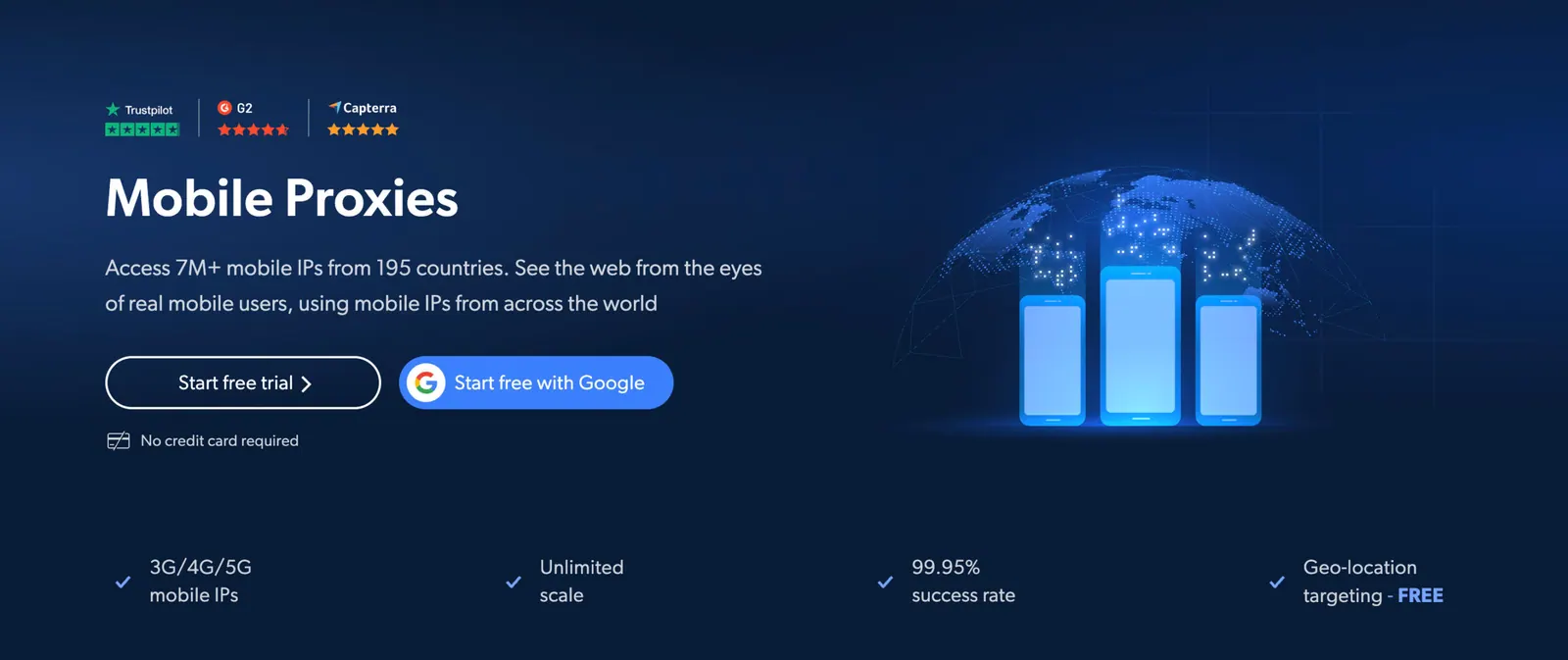
Bright Data’s mobile proxies route traffic through real mobile connections, with 7M+ mobile IPs advertised. They are used for app and mobile-site testing, mobile ad verification and market research where results differ on phones.
Advantages of Mobile Proxies
Mobile proxies offer several advantages:
- Many real users share each mobile IP, so websites are reluctant to block them.
- Traffic looks like it comes from a real phone on a mobile network.
- Mobile IPs change often, which adds an extra layer of rotation.
Like residential proxies, mobile proxies now require a KYC-verified business account.
Implementing Mobile Proxies
Integrating mobile proxies can improve test accuracy by simulating real user behavior, using the code examples Bright Data provides for common programming languages.
Connections use the same proxy endpoint as other networks, with HTTP, HTTPS or SOCKS5. Depending on your setup, Bright Data may ask you to install its SSL certificate for residential and mobile connections; its documentation covers the details.
ISP Proxies for Consistent Access
Bright Data’s ISP proxies are static IPs bought or leased from internet service providers for commercial use. Target sites treat them much like residential IPs, but because they run on servers they keep datacenter-like speed and stability. The network has 1.3M+ ISP IPs, available as a shared pool or as shared and dedicated unlimited IPs.
When to Use ISP Proxies
ISP proxies are especially useful when you need session persistence, or when datacenter proxies are being blocked but you want to keep server speeds and lower costs. Typical uses are ad verification, quality assurance, marketing work and long-lived account sessions.
Setting Up ISP Proxies
ISP proxies are also the main option for accounts without KYC, since Bright Data recommends them (or the Web Unlocker API) as the replacement for retired immediate-access residential proxies.
Setting them up means creating an ISP zone, choosing shared or dedicated IPs and the countries you need, and pointing your scraper or browser at the zone’s credentials. Bright Data’s documentation walks through the process with examples.
Pricing Structure of Bright Data Proxies
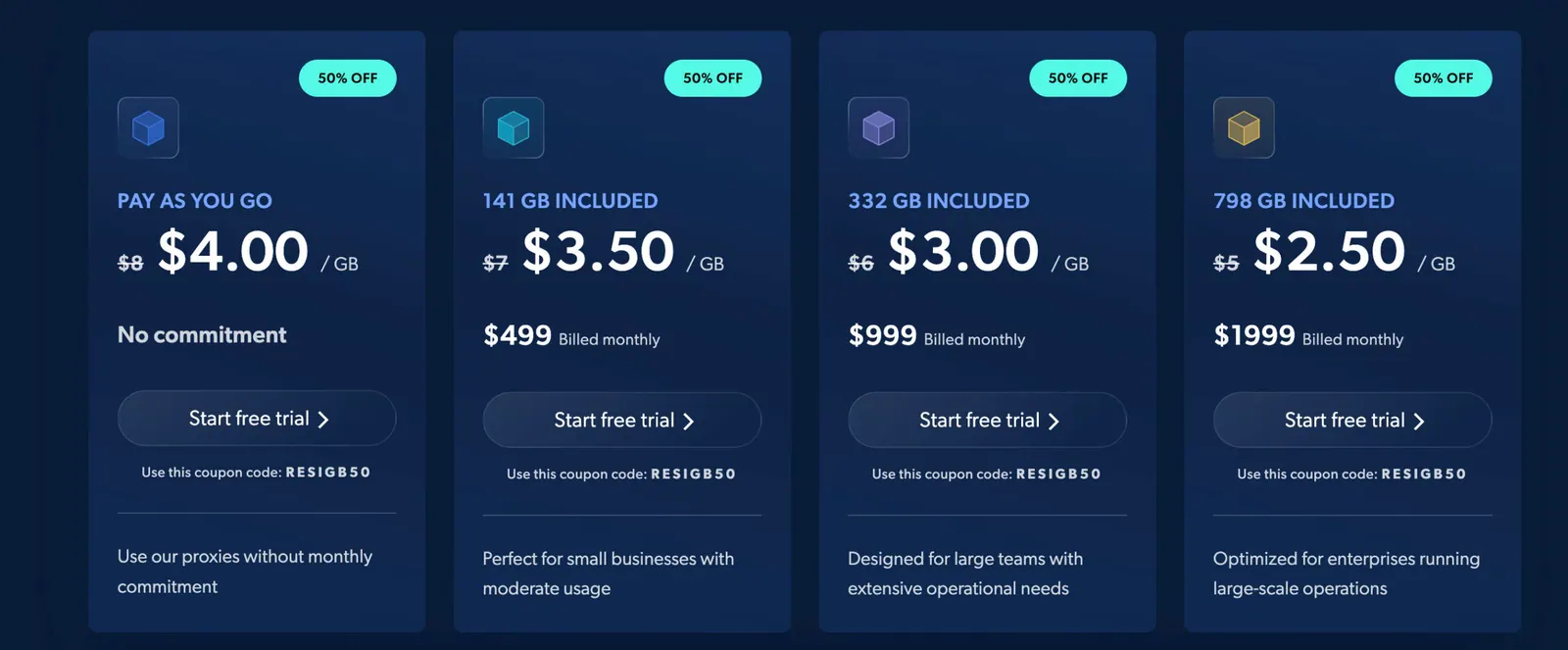
Bright Data works on a prepaid wallet: you deposit funds and products draw from the balance, with pay-as-you-go rates and monthly plans that lower the unit price. As of October 2026:
| Product | Starting price |
|---|---|
| Residential proxies | $8/GB pay-as-you-go (list price); monthly plans from $499 |
| ISP proxies | From $1.30 per IP |
| Datacenter proxies | $1.40 per IP for 10 IPs ($14/month), down to $0.90 per IP for 1,000 IPs |
| Browser API | From $5/GB |
| Web Unlocker and SERP API | From $1 per 1,000 requests |
Bright Data runs frequent promotions; in September 2026, for example, a coupon cut pay-as-you-go residential traffic by 50% to $4/GB. New accounts receive a one-time $2 trial credit for proxy products, valid for 7 days, plus a $5 bonus when they add a payment method.
Cost Comparison Across Proxy Types
The main downside of Bright Data is cost. At $8/GB pay-as-you-go, its list price for residential traffic is higher than Oxylabs ($6/GB on small plans), Decodo ($4/GB pay-as-you-go) and FloppyData ($1/GB), and the many plans and promotions make the final price harder to predict. For large companies, the network size, compliance certifications and managed APIs can justify the premium.
Disclosure: FloppyData is a commercial partner of cross-browser.org; see our About page for the full partner list.
Selecting a proxy provider requires considering factors such as:
- Pricing transparency
- The ability to meet specific project needs
- Evaluating the success rates of proxy services
- Assessing the speed of proxy services
These considerations ensure alignment with your scraping tasks’ performance needs, making the investment worthwhile.
Discounts and Promotions
Upon sign up, Bright Data offers:
- A one-time $2 trial credit for proxy products, valid for 7 days.
- A $5 bonus when you add a payment method, valid for 30 days.
- 5,000 free credits a month for the Web Unlocker API, SERP API, Scraper APIs, Scraper Studio and Browser API — these credits do not cover proxies.
Bright Data’s Ethical Practices and Compliance
Bright Data presents its proxy services as a way to collect public web data ethically and in compliance with the law. The company publishes an acceptable use policy and a Code of Ethics that guide how customers may use its networks.
Its compliance programme is one of its strongest points: identity checks for residential and mobile access, plus formal security certifications.
Data Collection Ethics
Bright Data says its residential IPs come from users who have opted in to the network and are compensated for participating, typically through partner applications.
The company also states compliance with key privacy regulations, including GDPR and CCPA, and requires KYC verification before customers can use its residential and mobile networks.
Privacy Policies and Terms of Service
Bright Data holds ISO/IEC 27001:2022, ISO 27017, ISO 27018 and SOC 2 Type II certifications, and lets customers request data deletion via [email protected].
As with any proxy provider, read the acceptable use policy before you start: some targets and use cases are restricted, and Bright Data blocks access to certain sites through its proxies.
User Experience and Support
Developers can manage zones, credentials and usage through the Bright Data API, a command-line tool and an MCP server for AI agents, alongside the web dashboard.
Dashboard and Tools
The dashboard lets you create zones for each proxy type, track data usage and manage proxy settings. Bright Data also publishes a real-time network status page and a browser extension.
The Proxy Manager, an open-source routing tool, adds rules for rotation, retries and traffic routing on top of the proxy networks.
Customer Support Feedback
Reviews of Bright Data’s support are mostly positive, and reviewers often mention knowledgeable staff who help with setup.
Some customers report slower communication during technical issues, so larger teams should ask about account management when they sign up.
Alternatives to Bright Data Proxies

Bright Data faces competition from many proxy providers with different strengths. Key competitors include FloppyData, Decodo (formerly Smartproxy), Oxylabs and Webshare, which often win on price or simplicity.
When choosing a proxy provider, it’s important to consider specific needs such as budget, required features, and intended use cases. Our list of the best proxy providers for web scraping compares 15 options.
Cheaper alternative: FloppyData
If price matters more than a giant network and enterprise paperwork, FloppyData is the most affordable alternative. Its rotating proxies cost $1.00/GB — an eighth of Bright Data’s $8/GB pay-as-you-go list price for residential traffic — and the same balance works as residential, mobile or datacenter traffic, so you can switch types at any time at no extra cost. Static ISP proxies start at $1.79 per IP and static datacenter proxies at $0.79 per IP, both with unlimited bandwidth, in 190+ locations. For protected targets, its Scraping API costs about $0.90 per 1,000 requests and handles browser rendering, CAPTCHAs and retries.
Competitor Analysis
Oxylabs is the closest like-for-like rival: it advertises a 99.95% average success rate and 0.6-second average response time, with residential traffic from $6/GB and plans from $30/month. Decodo charges $4/GB pay-as-you-go for residential traffic with a 3-day free trial, and Webshare is the budget option for datacenter proxies, with a free plan of 10 proxies.
Choosing the Right Proxy Provider
Understanding the pricing structure is vital to ensure that you select a proxy provider that fits your budget and needs. Estimate how many GB or IPs a month your project uses, then compare per-unit prices at that volume rather than headline “from” prices.
Bright Data makes most sense for companies that need its network size, compliance documentation and managed scraping APIs. Individuals, small teams and price-sensitive scrapers will usually get more for their money elsewhere.
Summary
Bright Data offers a comprehensive suite of proxy services — residential, datacenter, mobile and ISP — plus managed scraping products, backed by strong compliance and security certifications. Its residential network of 400M+ monthly IPs is among the largest available.
The trade-offs are price and access: residential traffic lists at $8/GB pay-as-you-go, and residential and mobile networks now require KYC-verified business accounts. For enterprise data teams it remains a standout choice; for smaller budgets, FloppyData’s $1/GB traffic or Decodo’s and Oxylabs’ plans are worth comparing first.
Frequently Asked Questions
What types of proxies does Bright Data offer?
Bright Data offers residential proxies (400M+ monthly IPs in 195+ countries), ISP proxies (static residential-grade IPs), datacenter proxies and mobile proxies, plus scraping products such as the Web Unlocker API, SERP API, Browser API and Scraper APIs.
How much do Bright Data proxies cost?
Residential traffic lists at $8/GB pay-as-you-go, and monthly residential plans start at $499. ISP proxies start at $1.30 per IP and datacenter proxies at $0.90 per IP at volume ($1.40 per IP for 10 IPs). Bright Data frequently runs promotions, so check its pricing page before you buy.
Does Bright Data have a free trial?
New accounts get a one-time $2 trial credit for proxy products, valid for 7 days, plus a $5 bonus when you add a payment method. Bright Data’s scraping APIs also include 5,000 free credits a month, but those credits do not cover proxies.
Do I need KYC to use Bright Data residential proxies?
Yes. Under a policy effective 19 October 2026, residential and mobile proxies require a KYC-verified business account. Accounts without KYC can use ISP or datacenter proxies or the Web Unlocker API instead.
Is there a cheaper alternative to Bright Data?
Yes. FloppyData sells rotating proxies at $1.00/GB, and one balance works as residential, mobile or datacenter traffic. That is an eighth of Bright Data’s $8/GB pay-as-you-go list price for residential traffic.

