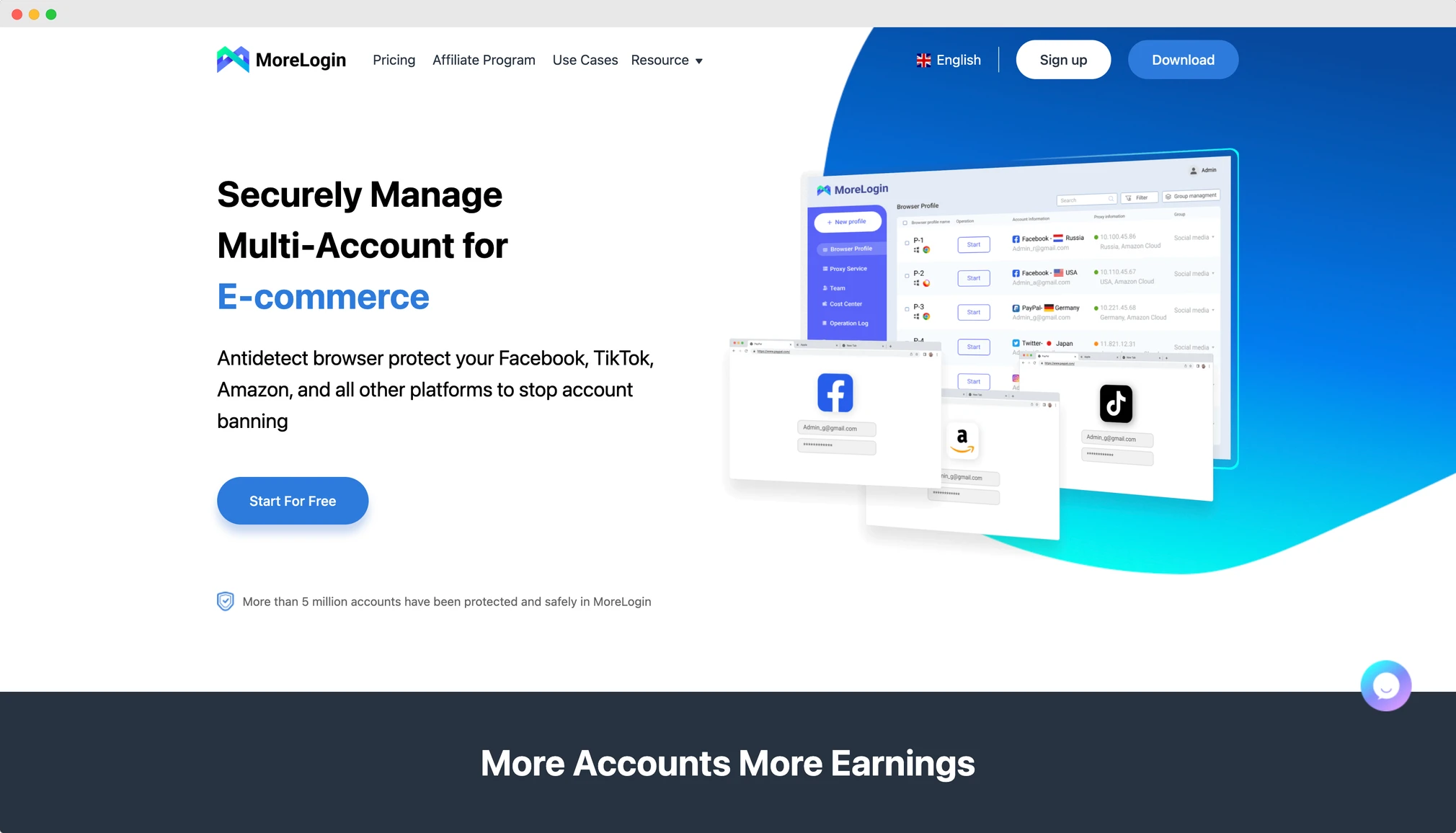
MoreLogin is an antidetect browser that gives every account its own isolated browser profile, and it now adds Android cloud phones and automation tools on top. It is one of the cheapest ways to start: a free plan with 2 profiles, and a Pro plan from $9/month for 10 profiles, or $5.40/month billed yearly.
Our verdict: MoreLogin is good value for budget-minded marketers, e-commerce sellers and automation users who don't mind a busy interface. Beginners and growing teams may prefer a simpler tool with a larger free plan.
MoreLogin at a glance
| Free plan | 2 profiles, 2 users, no time limit |
|---|---|
| Paid plans | Pro from $9/month (10 profiles, 2 users); $5.40/month billed yearly; Custom on request |
| Annual discount | 40% |
| Platforms | Windows, macOS, Linux; Android cloud phones; Android app announced |
| Browser engines | Chromium and Firefox |
| Automation | Synchronizer, no-code RPA, Local API (Selenium, Puppeteer), CLI, MCP for AI agents |
| Best for | Low-budget multi-account work, mobile app accounts, automation |
What is MoreLogin?
MoreLogin is an antidetect browser for running many online identities from one workspace. Each browser profile gets its own fingerprint, cookies, storage and proxy, so websites see each profile as a separate user on a separate device.
In 2026 the company describes the product as an account management workspace rather than just a browser. Next to local browser profiles it offers cloud browser sessions and Android cloud phones for mobile apps, plus team permissions and automation.
If you have used AdsPower, MoreLogin will feel familiar: both price their paid plans with a calculator based on profile and user counts, and both put a lot of controls on one screen.
MoreLogin Features
Key features of MoreLogin include:
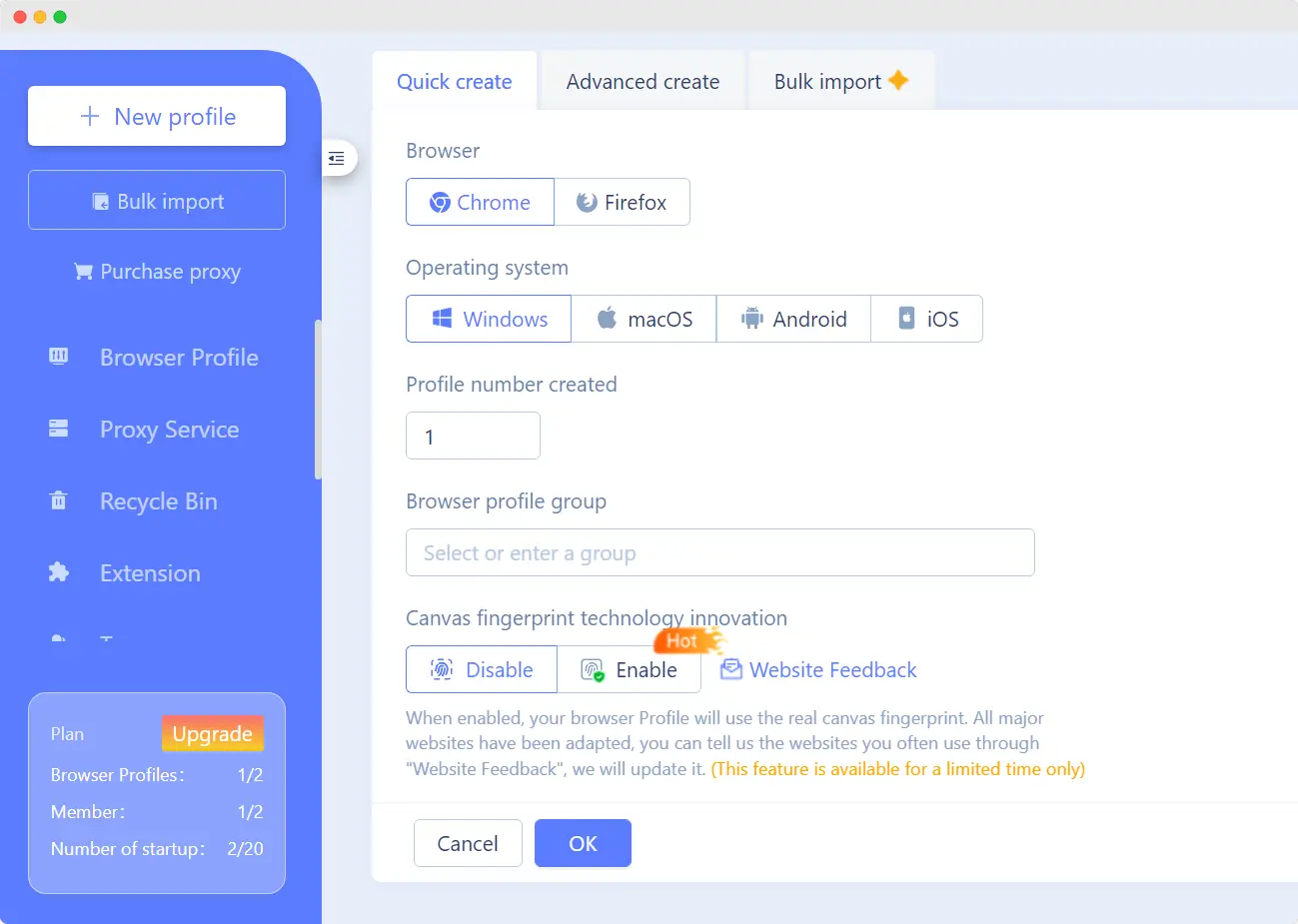
- Browser profile management: create, group and launch profiles individually or in bulk, with batch import of proxies and cookies.
- Fingerprint customization: profiles run on Chromium or Firefox kernels, and you can adjust the user agent, screen resolution, language, WebRTC mode and other parameters manually.
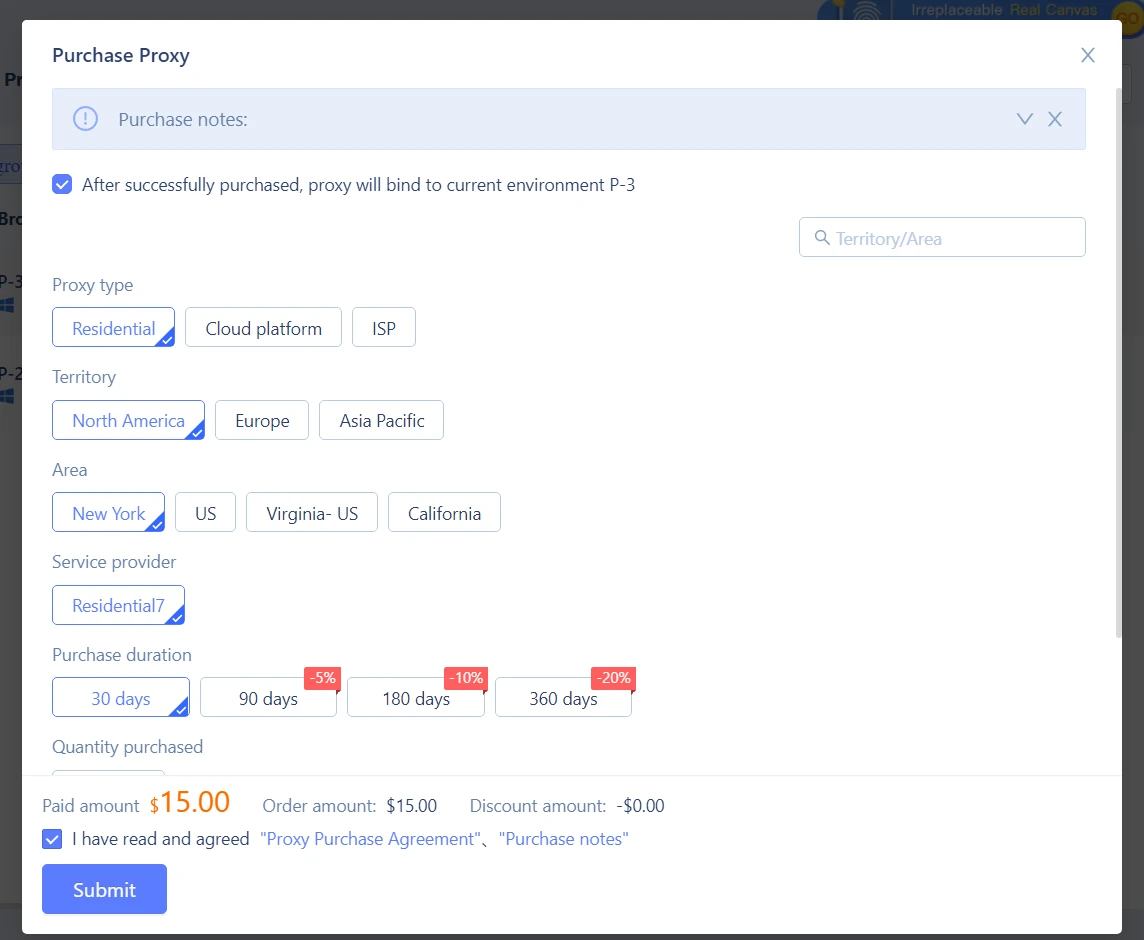
- Proxy support: assign a proxy to each profile, check the IP at launch and buy proxies inside the app if you don't have a provider.
- Cloud phones: Android 12 to 15 devices in the cloud for social media, e-commerce and short-video accounts, billed per minute ($0.006/min, capped at $1.50/day) or $23 to $25 per 30 days.
- Automation: a Synchronizer that mirrors clicks and typing across profiles, a no-code RPA builder, a Local API for Selenium and Puppeteer, a CLI and MCP access so AI agents such as Claude Code or Cursor can work inside MoreLogin profiles.
- Team cooperation: member permissions, password and cookie protection, page access rules and operation logs.
The main draw is breadth for the price: Synchronizer, Local API, profile transfer and team collaboration are all part of the free plan.
Every profile still needs a good proxy. If you bring your own, FloppyData is an affordable option: $1/GB rotating traffic that you can use as residential, mobile or datacenter IPs from one balance.
MoreLogin Pricing & Plans
MoreLogin has three plans:
- Free: $0 with 2 profiles and 2 users, forever. It includes the Synchronizer, Local API, profile transfer and team collaboration.
- Pro: from $9/month for 10 profiles and 2 users. You pick the profile count in a calculator: 50 profiles cost $25/month, 100 profiles $35/month, 400 profiles $80/month and 1,000 profiles $160/month. Each extra user adds $5/month. Pro also adds 24/7 online support.
- Custom: custom profile and team limits with a dedicated consultant, priced on request.
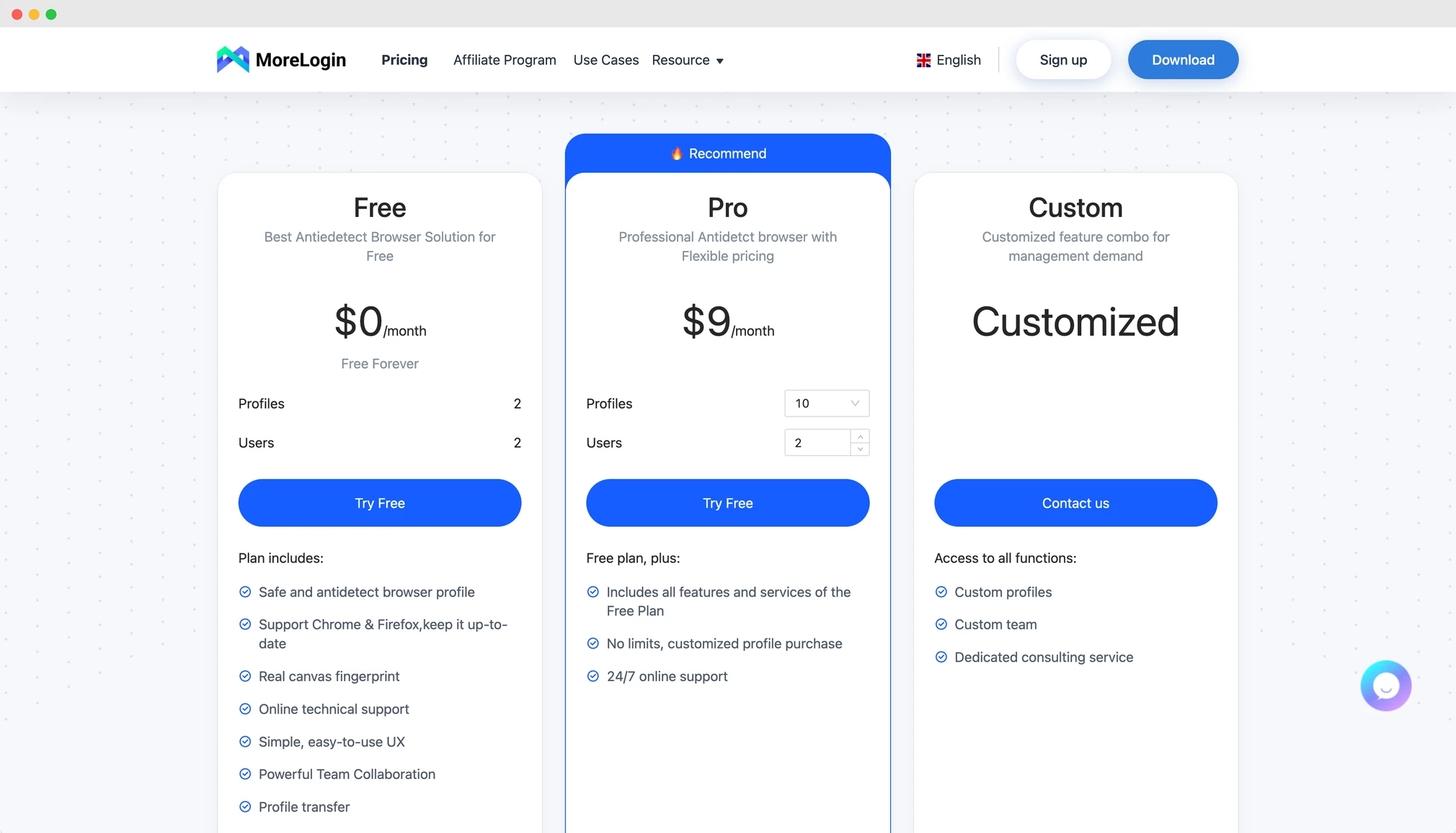
Paying yearly takes 40% off, so the entry plan drops to $5.40/month. Cloud phones are billed on top of the plan. For worked examples and team scenarios, see our MoreLogin pricing breakdown or the official MoreLogin pricing page.
For comparison, Gologin also starts at $9/month for 10 profiles but costs $4.50/month billed yearly, and its free plan has 3 profiles instead of 2.
MoreLogin Pros & Cons
Pros:
- Low entry price: $9/month for 10 profiles, or $5.40/month on annual billing.
- Flexible pricing: you pay for the exact number of profiles and users you need.
- Useful free plan features: Synchronizer, Local API and team collaboration are not locked behind a paywall.
- Two browser engines: Chromium and Firefox profiles.
- Mobile coverage: Android cloud phones for app-based accounts.
- Automation and AI: no-code RPA, API, CLI and MCP support.
Cons:
- Busy interface: many buttons and settings on one screen, which takes time to learn if you are new to antidetect browsers.
- Small free plan: 2 profiles, and no advertised trial of the Pro plan.
- Team seats cost extra: only 2 users are included; each additional member adds $5/month.
- Add-on costs: cloud phones and proxies are billed separately.
- No native mobile app yet: the Android app is announced but not released; mobile work happens on cloud phones.
- Hardware load: like any Chromium-based antidetect browser, running many profiles at once needs plenty of CPU and RAM.
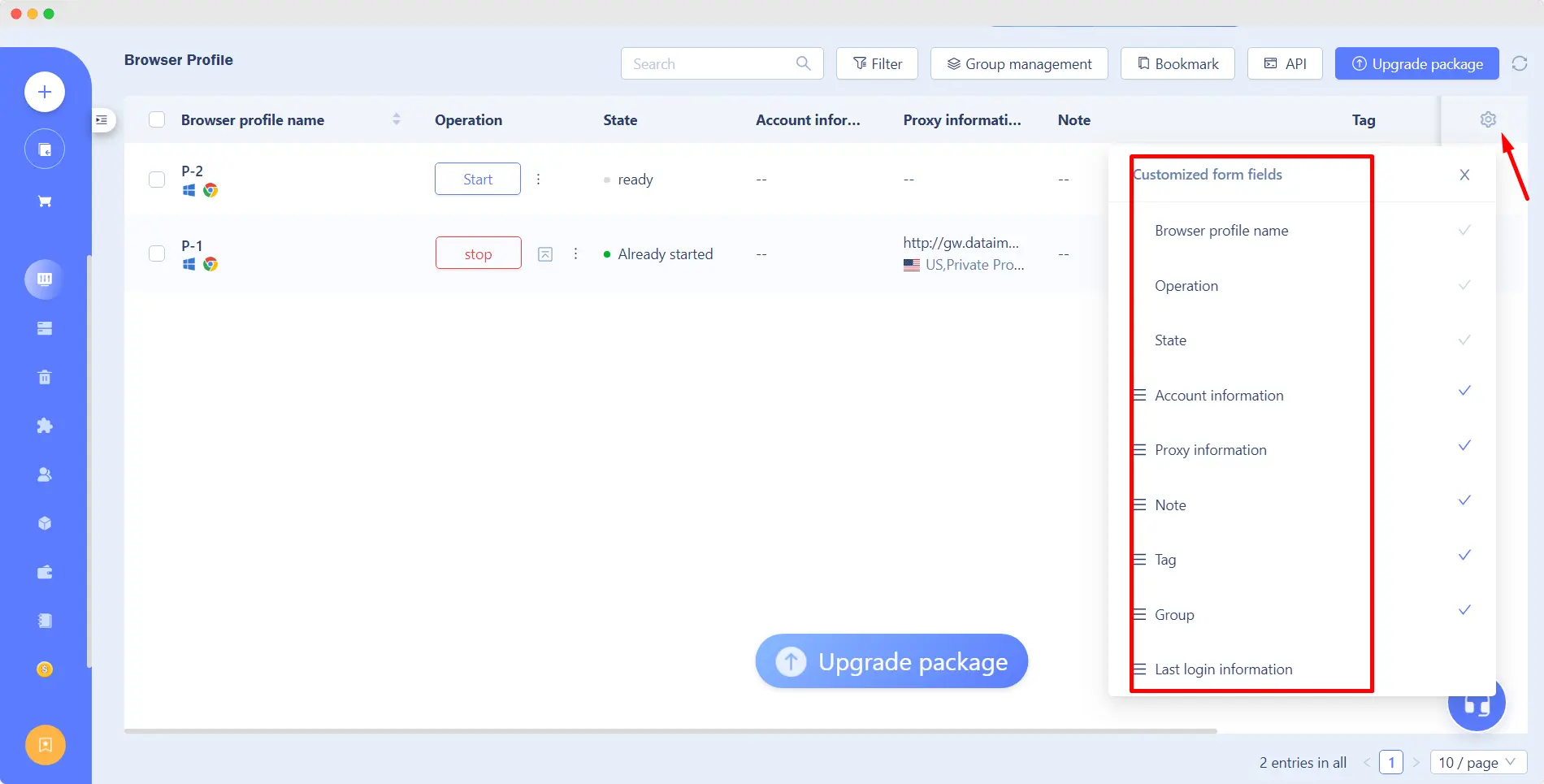
Common MoreLogin Use Cases
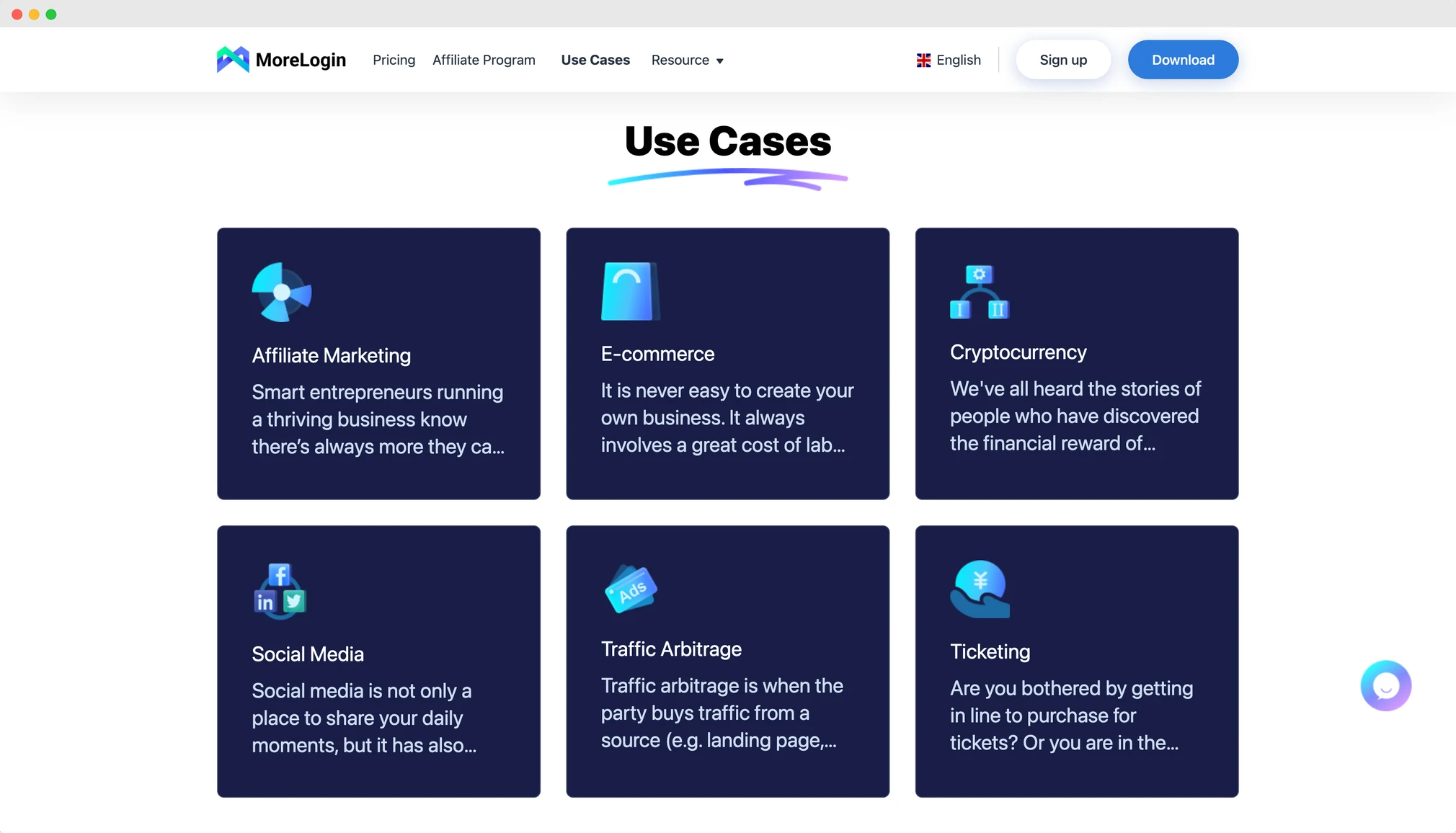
Like most antidetect browsers, MoreLogin is usually used for:
- Digital marketing and social media: run ad and social accounts for different clients or regions without mixing their sessions.
- E-commerce: manage several seller and store accounts, each in its own browser or Android environment.
- Agencies: give team members access to client accounts without sharing passwords.
- Web scraping and automation: drive many profiles through the API, RPA or AI agents.
- Market research: check prices, ads and search results from different locations.
- Software testing: test sites under different browser configurations and geolocations.
As with any such tool, use MoreLogin in line with the law and with each platform's terms of service.
Is MoreLogin worth it in 2026?
For a solo user or a small team on a tight budget, yes. MoreLogin's calculator keeps small setups cheap, the free plan already includes automation tools, and cloud phones cover mobile app accounts without extra hardware.
It is less convincing if you want the shortest learning curve or a team of several people from day one, because the interface is dense and every seat beyond the second adds to the bill. Test the free plan with your own proxies and target websites before committing.
Alternative worth considering: Gologin
If you want an easier start, Gologin is our top pick. It has a free-forever plan with 3 profiles, paid plans from $9/month ($4.50/month billed yearly), apps for Windows, macOS, Linux and Android, and a Cloud Browser that runs profiles with nothing installed. Paid plans include team members and profile sharing, and developers get a REST API plus Browser MCP for AI agents. See our Gologin review or the head-to-head Gologin vs MoreLogin comparison.
Comparisons
FAQ
Is MoreLogin free?
Yes. The free plan has no time limit and includes 2 browser profiles and 2 users, with no credit card required. New accounts also get 100 minutes of cloud phone time. MoreLogin does not advertise a time-limited trial of the Pro plan, so the free plan is the way to test it.
How much does MoreLogin cost?
The Pro plan starts at $9/month for 10 profiles and 2 users, or $5.40/month billed yearly (40% off). You add profiles with a calculator: 100 profiles cost $35/month and 1,000 profiles cost $160/month. Each extra user adds $5/month. Custom plans are quoted by the sales team, and cloud phones are billed separately.
Which platforms does MoreLogin support?
MoreLogin has desktop apps for Windows, macOS and Linux. Mobile accounts run on Android cloud phones (Android 12 to 15). A native Android app is listed as coming soon.
Does MoreLogin include proxies?
No free proxies are included. You can buy proxies inside MoreLogin or connect your own, one proxy per profile. Proxy quality matters as much as the browser, so use a reputable provider.
Can I automate MoreLogin?
Yes. MoreLogin includes a Synchronizer, a no-code RPA builder, a Local API that works with Selenium and Puppeteer, a CLI and MCP access for AI agents. The Synchronizer and Local API are available even on the free plan.
How is MoreLogin different from incognito mode?
Incognito mode only discards cookies and history after the session; websites still see your real device fingerprint and IP address. MoreLogin gives every profile its own fingerprint, cookies and proxy, so each profile looks like a separate device.