The best proxy provider for web scraping in 2026 depends on your targets and budget, but for most scraping projects FloppyData offers the best value: $1/GB rotating traffic that works as residential, mobile or datacenter IPs from one balance, static proxies with unlimited bandwidth, and a Scraping API for well-protected sites. Below we compare 15 providers on proxy types and entry prices, all checked on vendor websites in October 2026.
Web scraping means collecting data from websites with software tools — for price monitoring, market research, lead generation or competitor analysis. Most websites limit automated traffic with IP bans, rate limits, CAPTCHAs and geo-restrictions, so scrapers route requests through proxies to spread them across many IP addresses and locations.
Quick picks:
- Best value overall: FloppyData — $1/GB for residential, mobile or datacenter traffic from one balance.
- Best for enterprise scraping: Oxylabs and Bright Data — large networks and scraper APIs, at higher prices.
- Best free tier: Webshare — 10 free datacenter proxies with 1 GB a month.
- Best mid-priced bandwidth plans: Decodo (formerly Smartproxy).
Which proxy type you need depends on your goals. The main types are:
- Datacenter proxies: These proxies use IPs from datacenter servers rather than home or mobile connections. They are fast and cost much less than other types, which makes them a good fit for scraping public data from lightly protected sites. Websites can recognise datacenter IP ranges, so heavily protected sites often block them.
- Residential proxies: These proxies route your requests through IP addresses that internet providers assign to homes. They look like ordinary visitors and are blocked far less often, so they are the standard choice for protected sites. They cost more than datacenter proxies, and speed varies with the location and device behind each IP.
- Mobile proxies: These proxies use IPs assigned to phones by cellular networks. Many users share each mobile IP, so websites are reluctant to block them, which makes them useful for mobile-only content and the strictest targets. They are usually the most expensive type.
Here is how the three compare as a proxy for web scraping:
| Type | Speed | Block resistance | Cost | Best for | Main drawback |
|---|---|---|---|---|---|
| Datacenter | High | Low | Low | Scraping lightly protected, public data | Easy for sites to recognise and block |
| Residential | Medium | High | Medium | Protected and geo-restricted sites | Costs more; speed varies by IP |
| Mobile | Medium | Very high | High | Mobile-only content and the strictest targets | Usually the most expensive type |
So how do you choose? Start with datacenter proxies if your targets allow them, move to residential proxies when you get blocked, and keep mobile proxies for the hardest cases. Providers that let one balance cover several types, such as FloppyData, make it easy to switch without buying separate packages.
Next, we review 15 providers with their pros, cons and current entry prices, and finish with a comparison table.
1. FloppyData
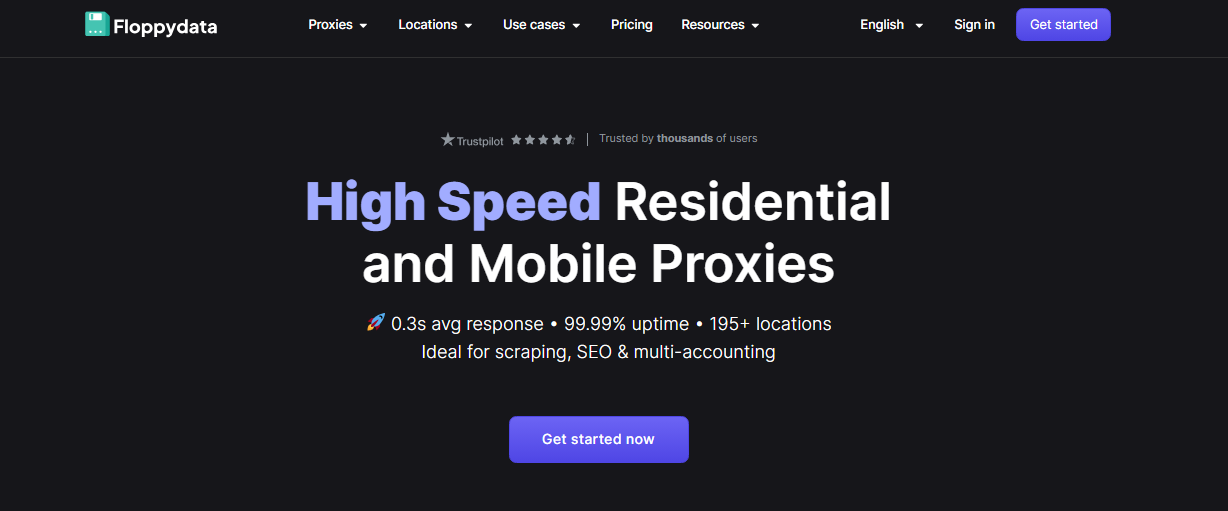 FloppyData is our top pick among residential proxy providers for web scraping. Its rotating traffic costs $1.00/GB, and the same balance works as residential, mobile or datacenter traffic — you can switch types at any time at no extra cost, which is ideal when a scraper needs cheap datacenter IPs for some targets and residential IPs for others. The network covers 190+ locations with country, city, ASN and IP-type targeting, supports HTTP and SOCKS5 over IPv4 and IPv6, and FloppyData claims a 95% clean IP rate.
Pros
- $1/GB rotating traffic usable as residential, mobile or datacenter IPs
- Static ISP proxies from $1.79 per IP and static datacenter proxies from $0.79 per IP, both with unlimited bandwidth
- 190+ locations with country, city, ASN and IP-type targeting
- Scraping API (about $0.90 per 1,000 requests) renders pages like a real browser, handles CAPTCHAs and retries failed attempts
- Cloud Browser: managed Chromium you drive over CDP with Playwright or Puppeteer on FloppyData proxies
- Works with any antidetect browser, including Gologin
Cons
- Static proxies are sold in bundles of 20, 50 or 100 IPs, not one at a time
- A younger brand than Oxylabs or Bright Data, with fewer independent reviews
Rotating proxies cost $1.00/GB for residential, mobile or datacenter traffic. Static residential (ISP) proxies start at $1.79 per IP per month and static datacenter proxies at $0.79 per IP per month, in bundles of 20, 50 or 100 IPs. The Scraping API costs about $0.90 per 1,000 requests.
2. Oxylabs Proxy
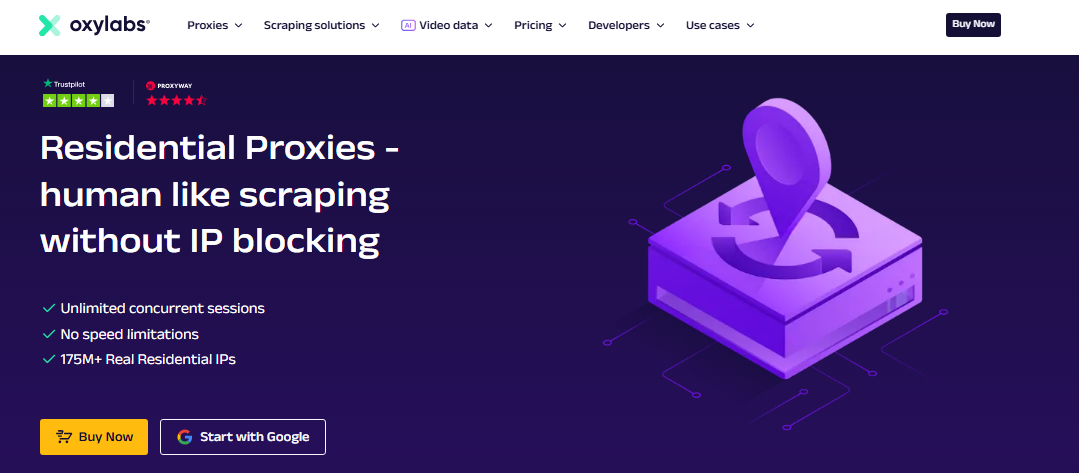 Founded in 2015 in Lithuania, Oxylabs is one of the largest proxy and scraping providers, with residential, mobile, ISP and datacenter proxies plus scraper APIs. It now sells one subscription that gives access to all products. Keep in mind that it has had legal disputes with Bright Data, dubbed the “proxy wars.”
Pros
- $5 of free welcome credit toward any product
- One subscription covers proxies and scraper APIs
- Unlimited concurrent sessions, with HTTP(S), HTTP3 and SOCKS5 support
- Scraper APIs from $0.50 per 1,000 results
Cons
- Residential traffic costs $6/GB at small volumes, more than budget providers
- The broad product range takes time to learn
Plans cost $30/month (Starter), $100/month (Basic) and $500/month (Flexible), with Enterprise from $2,500/month. Residential traffic costs $6/GB on small plans and falls to $2.50/GB above 1,000 GB; mobile starts at $7.50/GB, ISP proxies at $1.50 per IP and datacenter proxies at $1 per IP or $0.60/GB.
3. ASocks
 ASocks sells residential, mobile and “corporate” proxies either per GB or as unlimited per-proxy tariffs, and says it runs its own proxy infrastructure with clean addresses. Its website is available in several languages.
Pros
- Corporate proxies from $0.90/GB pay-as-you-go
- Pay-as-you-go per GB, with volume discounts up to 25%
- Unlimited tariffs priced per proxy instead of per GB
Cons
- Residential traffic at $5.50/GB pay-as-you-go costs more than budget providers
- Two pricing models (per GB and per proxy) take a moment to compare
Pay-as-you-go prices are $5.50/GB for residential, $6/GB for mobile and $0.90/GB for corporate proxies. Prepaid packages of 150, 500 and 1,000 GB bring them down to $4.13, $4.50 and $0.70 per GB. Unlimited tariffs cost $5 per proxy per month for residential or corporate and $15 for mobile.
4. Decodo (formerly Smartproxy)
NetNut, which held this spot in our 2025 list, has been removed. In July 2026 the FBI, working with Google and other partners, seized domains used by the NetNut residential proxy network (BleepingComputer report), and netnut.io now shows a seizure notice.
Decodo is the new name of Smartproxy; old smartproxy.com links now redirect to decodo.com. It offers residential, mobile, static residential and datacenter proxies, a Site Unblocker and a Web Data API, with an official MCP server, CLI and SDKs for AI-agent and automation workflows.
Pros
- 3-day free trial for proxies
- 115M+ residential IPs
- Monthly residential plans from $3.75/GB and $2/GB on 1 TB enterprise plans
- Web Data API from $0.15 per 1,000 requests, with $5 of free testing credit
- Free Chrome proxy extension
Cons
- Pay-as-you-go residential traffic costs $4/GB, four times FloppyData’s rate
- The cheapest per-GB rates require large monthly commitments
Residential proxies cost $4/GB pay-as-you-go, or $3.75/GB (3 GB) to $2.75/GB (100 GB) on monthly plans; enterprise plans run from $2.50/GB (250 GB) to $2/GB (1 TB). Mobile proxies start at $2.25/GB, static residential at $0.27 per IP and datacenter at $0.02 per IP. Site Unblocker starts at $0.95 per 1,000 requests.
5. IPRoyal
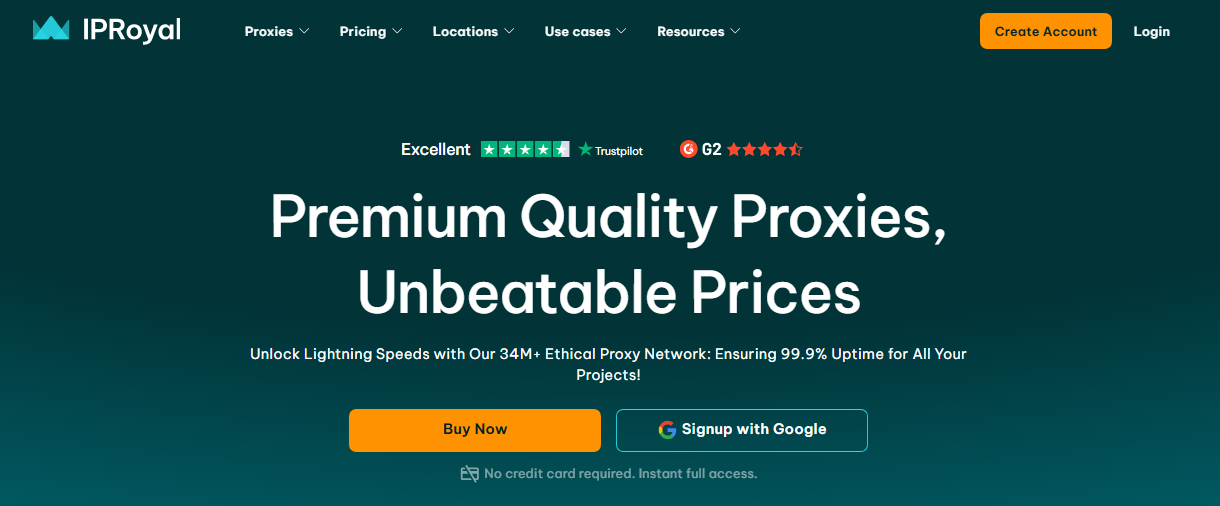 IPRoyal is a well-known proxy service provider for web scraping with a pool of 64M+ residential IPs in 195+ countries. It covers residential, ISP, datacenter and mobile proxies plus a Web Unblocker, and offers free tools such as a browser-based proxy checker.
Pros
- Pay-as-you-go residential traffic with no subscription required
- Per-GB price falls steeply with volume, down to $1.75/GB at 10 TB
- ISP proxies from $1.80 and datacenter proxies from $1.39 per proxy
- Web Unblocker from $1.00 per 1,000 requests
Cons
- Small residential packages are expensive: $7.35/GB for 1 GB pay-as-you-go
- Mobile proxies are priced per day (from $10.11), which suits long sessions better than occasional scraping
Residential proxies cost $7.35/GB for 1 GB pay-as-you-go ($7/GB with a subscription) and $5.51/GB for 10 GB, falling to $1.75/GB at 10 TB. ISP proxies start at $1.80 and datacenter proxies at $1.39 per proxy; mobile proxies start at $10.11 per day.
6. AstroProxy
 AstroProxy sells residential, datacenter and mobile proxies through “ports” that you can group by country, city and provider. Its distinctive feature is small packages: you can buy as little as 100 MB, which suits small businesses and test runs.
Pros
- Packages from 100 MB
- Pay-as-you-go option where you pay per port and per 10 MB used
- Volume discounts of up to 45%
Cons
- Residential traffic at $7.30/GB and mobile at $13.14/GB cost more than most providers here
- Port fees add to the per-GB price
Datacenter proxies start at $3.65/GB, residential at $7.30/GB and mobile at $13.14/GB, with ports at $0.10–$0.30 each; AstroProxy advertises rates from $2/GB at higher volumes.
7. Bright Data
 Bright Data, formerly Luminati Networks, is one of the biggest names in proxies and web data. GeoSurf’s parent company settled its patent disputes with Luminati in 2020. Today Bright Data offers 400M+ monthly residential IPs in 195 countries, ISP, datacenter and mobile proxies, scraping APIs, cloud browsers and datasets. If you are considering it, read our full Bright Data proxy review.
Pros
- One of the largest residential networks, with city, ZIP and ASN targeting
- Free, open-source Proxy Manager
- Scraping APIs with a free tier of 5,000 credits a month
- Security certifications including ISO 27001 and SOC 2 Type II
Cons
- Residential traffic lists at $8/GB pay-as-you-go, among the highest prices here
- Since October 2026, residential and mobile proxies require a KYC-verified business account
- Pricing has many plans and promotions, which makes costs harder to predict
Residential proxies list at $8/GB pay-as-you-go, with monthly plans from $499 and frequent promotional discounts. ISP proxies start at $1.30 per IP and datacenter proxies at $0.90 per IP. New accounts get a one-time $2 trial credit for proxies.
8. WebShare
 Founded in the United States in 2018, WebShare is a popular budget proxy service. Oxylabs acquired WebShare in 2022, but it still operates as a separate provider. It started with datacenter proxies and now also sells static and rotating residential proxies.
Pros
- Free plan with 10 proxies and 1 GB of bandwidth a month, no card required
- 100 datacenter proxies for $2.99/month
- HTTP and SOCKS5 support
- Used for web scraping, AI development, e-commerce and more
Cons
- The free plan is small and uses shared datacenter IPs
- Rotating residential traffic starts at $3.50/GB on small plans
Datacenter proxies cost $2.99/month for 100 proxies, static residential (ISP) proxies $6/month for 20, and rotating residential traffic $3.50/GB on a 1 GB plan, falling to $1.40/GB at 3,000 GB. Yearly billing saves 30%.
9. Soax
 SOAX is a proxy for web scraping with residential and mobile networks billed at one shared rate. It now sells platform plans: a free Sandbox and paid tiers that include credits and lower per-GB rates, with country, region, city and ISP targeting (ASN and ZIP on higher tiers).
Pros
- Free Sandbox plan to start
- One rate covers residential and mobile traffic
- 24/7 support on paid plans
- Credits on paid plans roll over for 60 days
Cons
- Paid plans start at $200/month, a high entry point for small projects
- Per-GB prices depend on which tier of target site you scrape, so costs take planning
The Sandbox plan is free, with per-GB rates from $2 to $5 depending on the target tier. Paid plans cost $200, $500, $1,500 and $3,000 per month and lower the rates, down to $0.35–$0.85/GB on Enterprise.
10. Infatica
 Infatica was established in 2019 and competes with providers such as SOAX and Bright Data. It offers residential (including IPv6), static ISP, datacenter and mobile proxies, plus web scraper and SERP scraper tools with free trial periods. It is often used for ad verification, PPC monitoring and web scraping.
Pros
- 7-day residential trial for $4
- Pay-as-you-go residential traffic at $4/GB
- IPv6 residential option
- Traffic monitoring dashboard
Cons
- No free proxy trial — the trial costs $4
- The best per-GB rates need prepaid packages of 100 GB or more
Residential proxies cost $4/GB pay-as-you-go, $3.84/GB for 25 GB ($96) and $2.90/GB for 241 GB ($700). Static ISP proxies start at $1.95 per IP and datacenter proxies at $1 per IP per month.
11. Hydraproxy
 Hydraproxy is a smaller provider focused on residential and mobile proxies, with rotating or static IPs and ISP proxies. Its packages are non-recurring, so you buy traffic when you need it instead of committing to a subscription.
Pros
- Non-recurring packages with no subscription
- Rotating and sticky IPs
- Simple tiered pricing by volume
Cons
- A smaller provider than the large networks in this list
- Mobile traffic costs more than residential, from $5/GB on small packages
Residential traffic costs $4/GB for 1–50 GB, $3.50/GB for 50–250 GB and $3/GB for 250–1,000 GB. International mobile proxies cost $5/GB for 1–10 GB, falling to $4/GB for 100–500 GB.
12. Proxyempire
 Proxyempire offers rotating residential IPs from 170+ countries, ISP proxies, rotating and dedicated mobile proxies and rotating datacenter proxies. Unused traffic rolls over and never expires, and you can start with a $1.97 trial.
Pros
- $1.97 trial with 150 MB that does not expire
- Unused GB roll over and never expire
- Rotating datacenter proxies from $0.35/GB
- Targeting by country, region, city, ISP and ASN
Cons
- The lowest advertised rates apply only to large packages
- Pay-as-you-go pricing relies on a promotional discount from a $7/GB list price
Rotating residential traffic costs $3.50/GB pay-as-you-go (shown as 50% off $7/GB) and falls to $1.50/GB on large plans. ISP proxies start at $2 per IP, rotating mobile at $2/GB, dedicated mobile at $20 per day and rotating datacenter at $0.35/GB.
13. Geonode
 Geonode is one of the cheapest proxy providers per GB. It sells residential, ISP and datacenter proxies and a Scraper API that covers scraping, mapping, crawling and search in one plan.
Pros
- Residential traffic from about $0.79/GB on small monthly plans
- $5 trial with 10 GB for 3 days
- Bandwidth rolls over until you cancel
- Free Scraper API plan with 1,500 requests a month
Cons
- Unlimited residential plans start at $1,800/month
- The lowest rates require a subscription rather than pay-as-you-go
Residential proxies cost $7.92/month for 10 GB ($0.79/GB) with a subscription, falling to $0.27/GB at volume. ISP proxies start at $1.25 per IP and datacenter proxies at $0.14/GB. Scraper API plans start free and cost $62.50/month for 250,000 requests.
14. Proxyrack
 Proxyrack prices most plans per thread or per port rather than per GB, which suits high-volume scrapers that would otherwise pay heavily for bandwidth. It offers 35M+ monthly residential IPs, datacenter and mobile proxies, and a Web Scraper API. Its threads-based model is more technical than per-GB plans, so it suits experienced users.
Pros
- Unmetered bandwidth on thread-based plans
- SOCKS5 support
- $5 three-day trial of Unlimited Residential
- Good geo-targeting options
Cons
- High entry prices: residential plans start at $110/month
- Thread-based pricing is harder to compare with per-GB providers
Premium Residential (billed per GB) starts at $110/month and Unlimited Residential (billed per thread) at $300/month. Rotating datacenter plans start at $150/month and static USA datacenter at $100/month; the Web Scraper API starts at $119/month.
15. Ipburger
 IPBurger offers 100M+ rotating residential IPs across 195+ countries, plus ISP, dedicated and mobile proxies. Its residential plans are monthly bundles that include a fixed amount of traffic.
Pros
- Wide location coverage
- Simple monthly bundles that are live in minutes
- Several proxy types under one account
Cons
- Entry price of $59/month is high for small projects
- Per-GB rates ($4.48–$5.90) are above the budget providers in this list
Residential plans cost $59/month for 10 GB ($5.90/GB), $149/month for 30 GB ($4.97/GB) and $269/month for 60 GB ($4.48/GB).
Comparison table
Entry prices were checked in October 2026.
| Provider | Proxy types | Price starts at |
|---|---|---|
| FloppyData | Rotating residential, mobile and datacenter; static ISP; static datacenter | $1/GB rotating; static datacenter from $0.79/IP |
| Oxylabs | Residential, mobile, ISP, datacenter | $6/GB residential; datacenter from $0.60/GB |
| ASocks | Residential, mobile, corporate | $0.90/GB corporate; $5.50/GB residential |
| Decodo | Residential, mobile, static residential, datacenter | $4/GB residential pay-as-you-go |
| IPRoyal | Residential, ISP, datacenter, mobile | $7.35/GB for 1 GB; datacenter $1.39/proxy |
| AstroProxy | Residential, mobile, datacenter | $3.65/GB datacenter |
| Bright Data | Residential, mobile, ISP, datacenter | $8/GB residential (list); datacenter from $0.90/IP |
| WebShare | Datacenter, static residential, rotating residential | Free plan; $2.99/month for 100 proxies |
| Soax | Residential, mobile | Free Sandbox ($2–$5/GB); plans from $200/month |
| Infatica | Residential, ISP, datacenter, mobile | $4/GB residential |
| Hydraproxy | Residential, mobile, ISP | $4/GB residential |
| Proxyempire | Residential, mobile, ISP, datacenter | $3.50/GB residential; datacenter from $0.35/GB |
| Geonode | Residential, ISP, datacenter | $0.79/GB residential (10 GB plan) |
| Proxyrack | Residential, datacenter, mobile | $110/month residential |
| Ipburger | Residential, ISP, dedicated, mobile | $59/month for 10 GB |
Frequently asked questions
Which proxy type is best for web scraping?
Start with datacenter proxies for sites with light protection, because they are the cheapest and fastest. Switch to residential or mobile proxies for sites that block datacenter IP ranges, such as large marketplaces, search engines and social networks. Static ISP proxies suit jobs that need the same IP for a long session.
What is the cheapest proxy provider for web scraping?
On a per-GB basis, Geonode (residential from about $0.79/GB on a 10 GB plan) and FloppyData ($1/GB) are the least expensive providers in this list. FloppyData’s balance also works as mobile and datacenter traffic, so one purchase covers every proxy type you need.
Is NetNut still available?
No. In July 2026 the FBI, working with Google and other partners, seized domains used by the NetNut residential proxy network, and netnut.io now shows a seizure notice. We removed NetNut from this list.
What happened to Smartproxy?
Smartproxy rebranded as Decodo. Old smartproxy.com links redirect to decodo.com, where residential proxies cost $4/GB pay-as-you-go or from $3.75/GB on monthly plans.
Should I use a scraping API instead of proxies?
A scraping API is easier when targets use heavy anti-bot protection, because the provider handles browser rendering, CAPTCHAs and retries for you. FloppyData’s Scraping API costs about $0.90 per 1,000 requests. Raw proxies are cheaper for simple targets and give you more control over your own scraper.